
Blast From The Past: The Bears' 1975 draft was Walter Payton, and more
- Mark Potash
- Apr 21, 2025
- 4 min read

Updated: Apr 22, 2025
Can you believe it’s been 50 years since the Bears drafted Walter Payton?
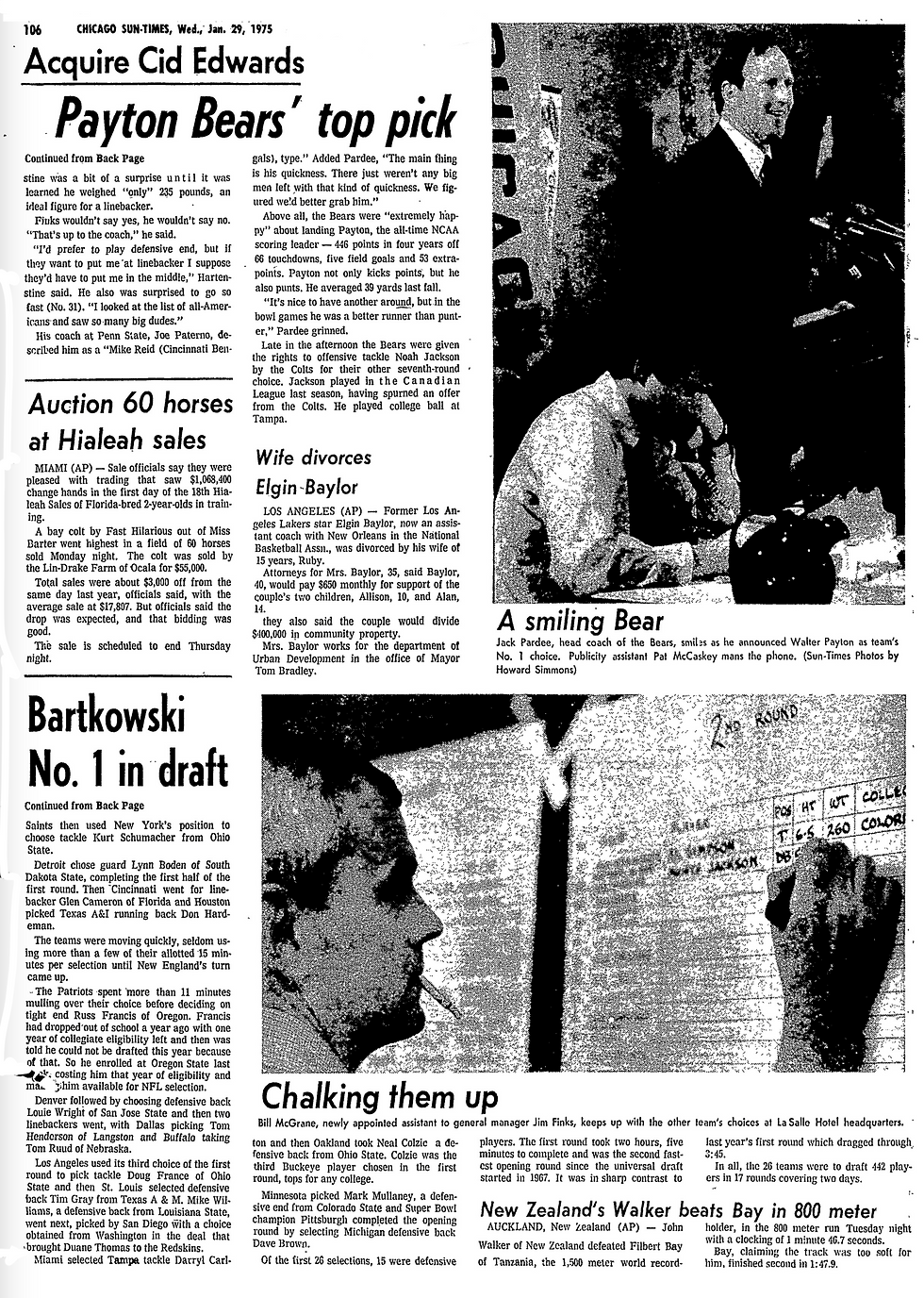
Besides the golden anniversary of the 1975 NFL Draft (which actually was held in January), the Bears’ interest in Boise State running back Ashton Jeanty also has evoked memories of the Bears and general manager Jim Finks sweating out the first three picks of the 1975 draft to take Jackson State’s Payton fourth overall — one of the first steps toward the Bears’ Super Bowl XX championship 10 years later.
While Jeanty plays in the shadow of the traditional college football powers at Boise State, Payton was in virtual seclusion at Jackson State in the early 1970s. He was the toast of his hometown of Columbia, Miss., which held a “Walter Payton Day” in his honor in 1975 and gave him the key to the city. But Payton was either unknown or ignored by major college football fans, despite his 3,563 rushing yards, 66 touchdowns and 6.1 rushing average. He still played at tiny Jackson State.
But he was no secret to NFL scouts. And despite his relative anonymity, Payton was projected to be the first running back taken in the draft, and likely in the top three picks in 1975. And that was in the days of a much shorter run-up to the draft, which was held on Jan. 28, 1975 — 16 days after the Super Bowl.

After a mediocre performance in the East-West Shrine Game (16 carries, 45 yards, 2.8 average), Payton starred in the Senior Bowl, where his South team quarterback was future Bears teammate Bob Avellini. Payton had 13 carries for 73 yards and two pass receptions for 18 yards in the Senior Bowl, which ended in a 17-17 tie. He also returned two kickoffs and punted three times for a 41.0-yard average. And his trademark tenacity in practices that week also made an impact.
(Typifying Payton’s under-the-radar status at that point, the Senior Bowl panel (that included Bears Hall of Famer Red Grange) voted quarterback Steve Bartkowski the MVP of the game (and a 1975 Dodge Charger), but pro scouts in attendance said Payton was more deserving.)

The Bears might come a few picks short of drafting Jeanty if they stay at No. 10. But they have other options. In 1975, Finks and the Bears targeted Payton as the best player in the draft, ahead of Bartkowski, the clear No. 1 overall pick. And the Bears had the No. 4 overall pick after winning a coin flip with the Browns, who also were 4-10 in 1974.
Finks wasn’t alone in his evaluation of Payton. Patriots coach and general manager Chuck Fairbanks said Payton was his No. 1 overall player in the draft. “Walter looks like he’s got a chance to be something special,” said Fairbanks, who had the 15th overall pick in that draft and no shot at Payton.
Finks, with much more to lose than Fairbanks, did his best to hide his infatuation with Payton. He talked up North Carolina guard Ken Huff, Auburn center Lee Gross, Houston 6-foor-8 defensive end Mack Mitchell (a year after 6-9 Ed “Too Tall” Jones went to the Cowboys with the first overall pick) and Ohio State offensive tackle Kurt Schumacher.
And when it came to running backs, all signs pointed to Texas A&I fullback Don Hardeman — an intriguing power runner who had switched to running back from linebacker as a senior. When asked by the Cleveland Plain Dealer’s. Chuck Heaton about Payton, Finks called it a “good guess,” but added, “We’re also interested in [Mack] Mitchell. We have to find someone ho can step in and play for us right away.”


There weren’t the mock drafts in those days that we see today, but various publications had the Bears taking Hardeman, Huff, Grambling defensive end Gary “Big Hands” Johnson. The Bergen (N.J.) Record’s Vinny Di Trani had the Bears taking Payton.
As Draft Day neared, Bartkowski and Maryland defensive tackle Randy White seemed like locks with the first two picks (to the Falcons and Cowboys). The Colts at No. 3 had options, including running back. But general manager Joe Thomas took Huff, clearing the way for the Bears to take Payton — similar to the Trailblazers taking Sam Bowie so the Bulls could take Michael Jordan in the 1984 NBA draft.


Huff was a solid starter for six seasons with the Colts — above-average but below Pro Bowl-level — before getting cut in a salary dispute in 1982 and finishing his career with the Redskins through the 1985 season.
Payton, of course, became arguably the greatest all-around running back of all-time — winning the NFL’s Most Valuable Player award in 1977 (1,852 rushing yards, 14 rushing touchdowns) and breaking Jim Brown’s the all-time rushing record (finishing with 16,726 rushing yards and 110 touchdowns).
For what it’s worth, Mack Mitchell went to the Browns at No. 5; Big Hands Johnson went to the Chargers at No. 8 (and became a four-time Pro Bowl player); Kurt Schumacher went to the Saints at No. 12; Don Hardeman went to the Oilers at No. 15 (he rushed for 1,460 yards and 11 touchdowns in five NFL seasons). Lee Gross went to the Saints in the second round (No. 32).
Payton alone would have made the 1975 draft a winner for Finks, who was in his first draft as the Bears' GM. But as it turned out, he got much more out of it. The 17-round 1975 draft, in fact, produced eight players who would start on the 1977 Bears team that finished 9-5 and made the playoffs for the first time since 1963 — Payton (1-4), defensive end Mike Hartenstein (2-31), cornerback Virgil Livers (3-83), guard Revie Sorey (5-110), quarterback Bob Avellini (6-135), linebacker Tom Hicks (6-151), safety Doug Plank (12-291) and fullback Roland Harper (17-420).
For Jim Finks, it was just the beginning.


Comments