
My 100 favorite collectibles ... No. 92 — Baseball's All-Star Game

Babe Ruth appropriately put an indelible stamp on the inaugural All-Star Game in 1933 at Comiskey Park by hitting the first home run in All-Star Game history — a two-run shot off the Cardinals' Wild Bill Hallahan in the third inning of a 4-2 victory for the American League. But it's lesser known that Cubs pitcher Lon Warneke hit the first triple in All-Star Game history — a hit to right field in the bottom of the sixth inning — and scored the first National League run in All-Star Game history.
Warneke, who went 109-72 in six full seasons with the Cubs from 1931-36, also earned the save in the National League's first victory in the All-Star game in 1936. He pitched the final 2 1/3 innings of a 4-3 victory, retiring Joe DiMaggio — then a Yankees rookie outfielder — with the tying run on second for the final out. Cubs teammate Augie Galan homered in that game to help the NL win the All-Star Game after losing the first three.

Cubs and White Sox players have had moderate impact in the All-Star Game. When Miguel Vargas homered in the All-Star Game last week at Citizens Bank Park in Philadelphia, he was just the third Sox player to homer in an All-Star game. The others are Frank Thomas in 1995 and Magglio Ordonez in 2001. Only five current teams have fewer All-Star Game homers, and all of them entered MLB in 1969 or later — the Padres, Brewers, Blue Jays, Marlins and Diamondbacks.
Other notable Chicago All-Star Game moments:
— White Sox Hall of Famer Al Simmons was the first player with three hits in an All-Star Game. Simmons, an All-Star in each of his three seasons with the Sox from 1933-35, had two doubles and a single in 1934 at the Polo Grounds, a 9-7 American League victory. He's the only Sox player to have two hits in an All-Star Game.
— Cubs third baseman Bill Madlock is still the only Chicago player to win MVP honors in the All-Star Game, sharing the award with Mets pitcher Jon Matlack in 1975. Madlock's two-run, bases-loaded single off Sox reliever Rich Gossage in the top of the ninth inning broke a 3-3 tie
and led the NL to a 6-3 victory at County Stadium in Milwaukee.
— While Pete Rose bowling over Ray Fosse to score the winning run in the 12th inning is the most memorable moment of the 1970 game, it was Cubs outfielder Jim Hickman who hit the single to set that play in motion. Hickman was an unremarkable player for seven seasons with the Mets and Cubs until 1969. He had a breakout season at 33 in 1970 and made the All-Star team for the first (and only) time, when he was hitting .335 with 19 home runs and 59 RBIs in July. He was chosen over teammate Billy Williams, who somehow did not make the All-Star team despite hitting .321 (ninth in the NL) with 26 home runs (third) and 80 RBIs (second).
— Cubs reliever Bruce Sutter was the winning pitcher in the 1978 and 1979 All-Star Games. Sutter's victory in 1979 at the Kingdome in Seattle was a bit fortunate. He allowed the base hit to Graig Nettles in the eighth inning that led to Dave Parker's unreal throw from right field to nail Brian Downing at the plate and preserve a 6-6 tie. The NL scored the lead run in the ninth inning and Sutter pitched a scoreless bottom of the ninth to earn the victory.
— Four White Sox pitchers have been the winning pitcher in the All-Star Game: Early Wynn (1958), Jack McDowell (1993), James Baldwin (2000), Mark Buehrle (2005) and Chris Sale (2013).
Fans have selected the All-Star starters intermittently since the game's inception. After Reds fans stuffed the ballot box and helped seven of their starters win starting All-Star spots fan voting was removed but returned in 1970, with Gillette sponsorship.


Chicago has hosted the All-Star Game seven times. The White Sox in 1933, 1950, 1983 (Comiskey Park) and 2003 (U.S. Cellular Field); the Cubs in 1947, 1962 and 1990 (Wrigley Field). The Cubs will host the All-Star Game in 2027.


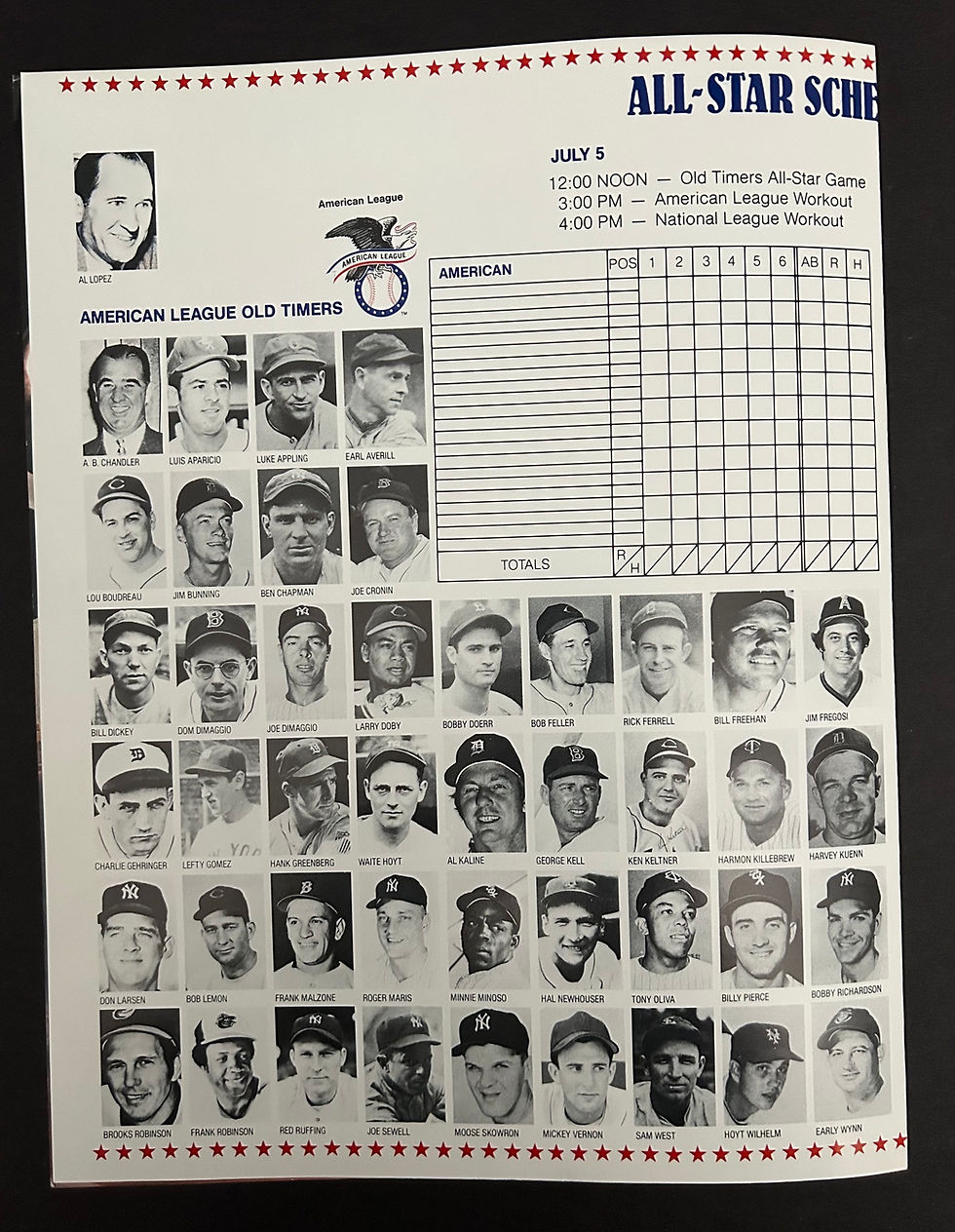

I attended the All-Star Game workouts as a fan in 1983 and took these pictures during the media availability portion of the day.


Comments