
My 100 favorite collectibles ... No. 100: Press passes


When I moved from the South Side to Lincolnwood at age 8 in 1967, one of my first friends at Rutledge Hall was the daughter of Jack Rosenberg, was the longtime sports editor of WGN. The Rosenbergs had a really cool basement, with all sorts of sports memorabilia. The highlight — for me anyway — was Jack's glass-topped office desk, which was covered with a collage of press passes he had accumulated through years of traveling while covering events for WGN Sports. The legendary and controversial 1966 Notre Dame-Michigan State 10-10 tie was one of them.
So when I became a sportswriter — starting as a journalism student at Missouri in 1979 — the press pass was a sacred item that should be treasured. And, inspired by Jack's display on his office desk, over the next 46 years, I kept just about every press pass I received — from the Kansas City Chiefs' opener against the Baltimore Colts in 1979 at Arrowhead Stadium to the Bears' upset of the Packers at Lambeau Field in the 2025 finale. (My eventual Sun-Times colleague, Rick Morrissey, was the polar opposite — often discarding his press pass before he even left the press box.)
Each one of them brings back fond memories — the Public League semifinals at the Amphitheater, the NBA Finals, the Keebler International Track and Field Invitational at York High School, the Maui Classic, the Sean O'Grady-Andrew Ganigan WAA title fight at Little Rock Coliseum, the Stanley Cup Final, the IHSA state basketball tournament, the Senior Bowl, the McDonald's High School All-American Game, the National Sports Collectors' Convention, the Chicago-to-Mackinac Yacht Race, the Cubs and Reds at Wrigley Field, the Nike Basketball Camp and of course, the Jay Cutler Volleyball Tournament on the Lakefront, among so many other events.
I can't list them all, but here are a few of my favorites from events I covered:

The Blackhawks' 4-3 overtime victory against the Flyers in Game 6 of the Stanley Cup Final at Wachovia Center in Philadelphia to clinch their first Stanley Cup title in 49 years was a memorable moment with the most awkward finish to a championship event ever. Patrick Kane's game-winning goal in overtime from a sharp angle off a nifty one-on-one move snuck underneath the padding of the goal and was missed by just about everyone but Kane and a couple of other players. That led to an awkward moment when even many of the Hawks were unaware they had just won the Stanley Cup.
After a moment of suspended animation, the Blackhawks celebrated and then the goal was confirmed on replay and they celebrated some more. It was awkward and stunning, but at least most of us covering the Hawks were able to see it live. When the Hawks scored two goals in 17 seconds of Game 6 against the Bruins in 2013, many of us were in the press room at TD Garden putting the finishing touches on a "Blackhawks lose" story. Without a live feed, we "heard" the goals by the crowd reaction. Sometimes, you have a better seat than we do.

As a college senior in 1981, I took a Greyhound bus from Columbia, Mo. to Wichita, Kan. to cover the McDonald's High School All-American Game at Henry Leavitt Arena. As it turned out, Patrick Ewing of Cambridge, Mass., the Georgetown-bound star of the 1981 All-America class, did not participate because he had already played in two All-Star games. But it didn't matter, because the McDonald's game became a prescient showcase for Michael Jordan of Wilmington, N.C., who scored 30 points and had six steals to lead the East to a 96-95 victory over the West.
With his team trailing 93-92, Jordan hit a short bank shot with 1:14 to go to give his team the lead. Trailing 94-93, Jordan was fouled and hit two free throws to give the East a 96-95 lead that held up. It was just the start of those kind of heroics for Jordan.
I was covering the game as a free-lancer for the Louisville Courier-Journal. I led my story with Jordan. Alas, they were only interested in Manuel Forrest of Louisville Moore, who was going to Louisville in the heart of the Denny Crum Era. Jordan wound up on the cutting-room floor. He wouldn't be Michael Jeffery Jordan for another year.
One footnote from that game: Though Jordan was the star of the McDonald's game, he wasn't named the MVP — probably because his late-game heroics (while or after the voting was done) put him over the top. The MVP award went to Adrian Branch of Hyattsville (Md.) DeMatha. The West team's Aubrey Sherrod — the people's choice from Wichita who had yet to commit to a college — was named a co-MVP. It was an early Jordan snub that somehow did not make Jordan's memorable Hall of Fame speech. Both Branch and Sherrod wound up in Bulls' training camp in 1985 — you have to believe that Jordan, who never forgets any slight (real or imagined), surely reminded Branch and Sherrod who the real MVP of that 1981 McDonald's game was.

The Bears have had some memorable moments in their playoff seasons — the opener against the Packers in 1963; the victory over the Chiefs in 1977, the rout of the Cowboys in 1985. But rarely if ever have they had back-to-back moments like they did in 2001, when safety Mike Brown beat the 49ers and Browns with Pick 6s in back-to-back weeks at Soldier Field.
It started in Week 7, with the Bears on a four-game winning streak after an encouraging opening loss to the defending Super Bowl champion Ravens on the road. Trailing 31-16 in the fourth quarter, the Bears scored two touchdowns in the final 4:08 to tie. On the first play of overtime, Brown intercepted a Jeff Garcia pass that was deflected byTerrell Owens and returned it 33 yards for an exhilarating victory that sent Bears fans at Soldier Field into delirium.
Shane Matthews and the Bears outdid themselves the following week, rallying from a 21-7 deficit with two touchdowns in the final 28 seconds to force overtime. Brown again picked off a deflected pass and returned it 16 yards for another game-winning score. The Bears finished 13-3 and lost to the Eagles in the playoffs at Soldier Field.

Still on the prep beat in 1992 (Westinghouse upset King in the city championship game that season), I was a late addition to the Bulls playoff beat in the NBA Finals, subbing for Brian Hewitt. The Bulls were up 3-2 in the series heading into Game 6, but trailed by 15 points in the fourth quarter. Sparked by a Bobby Hansen three-pointer and steal, the Bulls' bench was so strong in a rally that got the Bulls within striking distance that Phil Jackson kept the second unit (and B.J. Armstrong) on the floor.
Only after the Bulls took the lead did Jackson bring in Michael Jordan, Scottie Pippen, Horace Grant and the starters to close the door, which they did for a 97-93 victory that clinched their second consecutive NBA title.

The Blackhawks won three Stanley Cups in six seasons, but they were far more resilient than dominant — the Quenneville Hawks had an uncanny knack for measuring an opponent, reeling them in and getting stronger as each series went on and as each postseason went on. Game 5 against the Predators in the first round of the 2010 playoffs was the first real example of that.
With the series tied 2-2, the Hawks were seconds away from trailing 3-2 and facing an elimination game on the road when Patrick Kane scored a shorthanded goal (with an extra attacker) with 13.6 seconds left in regulation. (The winning play started when the Predators' Martin Erat got greedy and tried to feed Jason Arnott in front of the Hawks' net with a backhand pass, but the puck deflected off the Hawks goal for a turnover — that's another hallmark of the Hawks success in that run — they had a way of making you play stupid.)
The Hawks won in overtime when Marian Hossa, just out of the penalty box after a five-minute major for boarding Dan Hamhuis, parked himself in front of the Predators net and easily tapped in a deflected shot/pass by Brent Sopel. The Hawks won Game 6 in Nashville to clinch the series en route to their first Stanley Cup since 1961.

The Bulls made NBA history on April 16, 1996 when they beat the Bucks 86-80 at the Bradley Center in Milwaukee for their 70th win of the season — the first team in league history with 70 victories. (It was a sluggish game for the Bulls, who seemed to feel the weight of the achievement. They rallied from a 70-64 deficit in the fourth quarter to win, but even that was in workmanlike fashion rather than Jordan brilliance.
The Bulls were 70-9 at that point and had a chance to finish the season with single-digit losses. But — at the end of a long, arduous season of spectacular feats, lost to the Pacers at home when Chicagoan Eddie Johnson hit a free throw after being fouled by Jordan. They finished 72-10 but re-ignited in the playoffs to go 15-3 (losing two of those games after taking a 3-0 lead over the Sonics in the Finals) en route to their fourth NBA championship in six seasons.

The Cubs actually clinched the NL Central title in 2016 when the Giants beat the Cardinals on the West Coast on Sept. 15, so they were going to celebrate win or lose against the Brewers on Sept. 16 at Wrigley Field. In true 2016 Cubs fashion, they won with a flair — rallying for two runs in the ninth inning to tie, then winning 5-4 on Miguel Montero's home run leading off the 10th inning.
A raucous celebration in the Cubs' clubhouse ensued, with music, beer, champagne and even owner Tom Ricketts doing shots. While the World Series was still a long way away, this was no time to act like they had been here before, because they had not.
"We just won one of the toughest divisions in all of baseball and we did it by a landslide," first baseman Anthony Rizzo told me. "We have to celebrate this because we've been so good all year. Guys have been grinding all year. This is a huge steppingstone to where we want to be and we're going to celebrate every way along the way."
That they did, with a memorable playoff run that mimicked the resilience of the Blackhawks' Stanley Cup run. The Cubs beat the Giants in four games in the NLDS and the Dodgers in six in the NLCS to avoid winner-take-all games in each series. And when they faced elimination against the Guardians in the World Series — down 3-1 — they won three straight to break a 108-year World Series drought.

My first "beat" ever was covering the Kansas City Chiefs as a junior at Missouri in 1979. I had no idea what I was doing, but I learned a lot. The Chiefs coach was Marv Levy, who not only is a fellow Chicagoan, but went to the same South Side grammar school (Bradwell) and high school (South Shore) as my mom.
I wasn't very good, but I learned a lot. Two lessons: Always talk to the back-up quarterback — rookie Steve Fuller not only started 12 games in place of Mike Livingston, but started two playoff games for the 1984 Bears and was a back-up on the '85 Super Bowl team); And talk to all the linemen — Chiefs guard Tom Condon and rookie defensive tackle Ken Kremer became two of the biggest agents in the NFL.
This press pass is from the Chiefs' regular-season opener against the Baltimore Colts at Arrowhead Stadium. The Chiefs won 14-0, but slumped after a 4-2 start and finished 7-9.
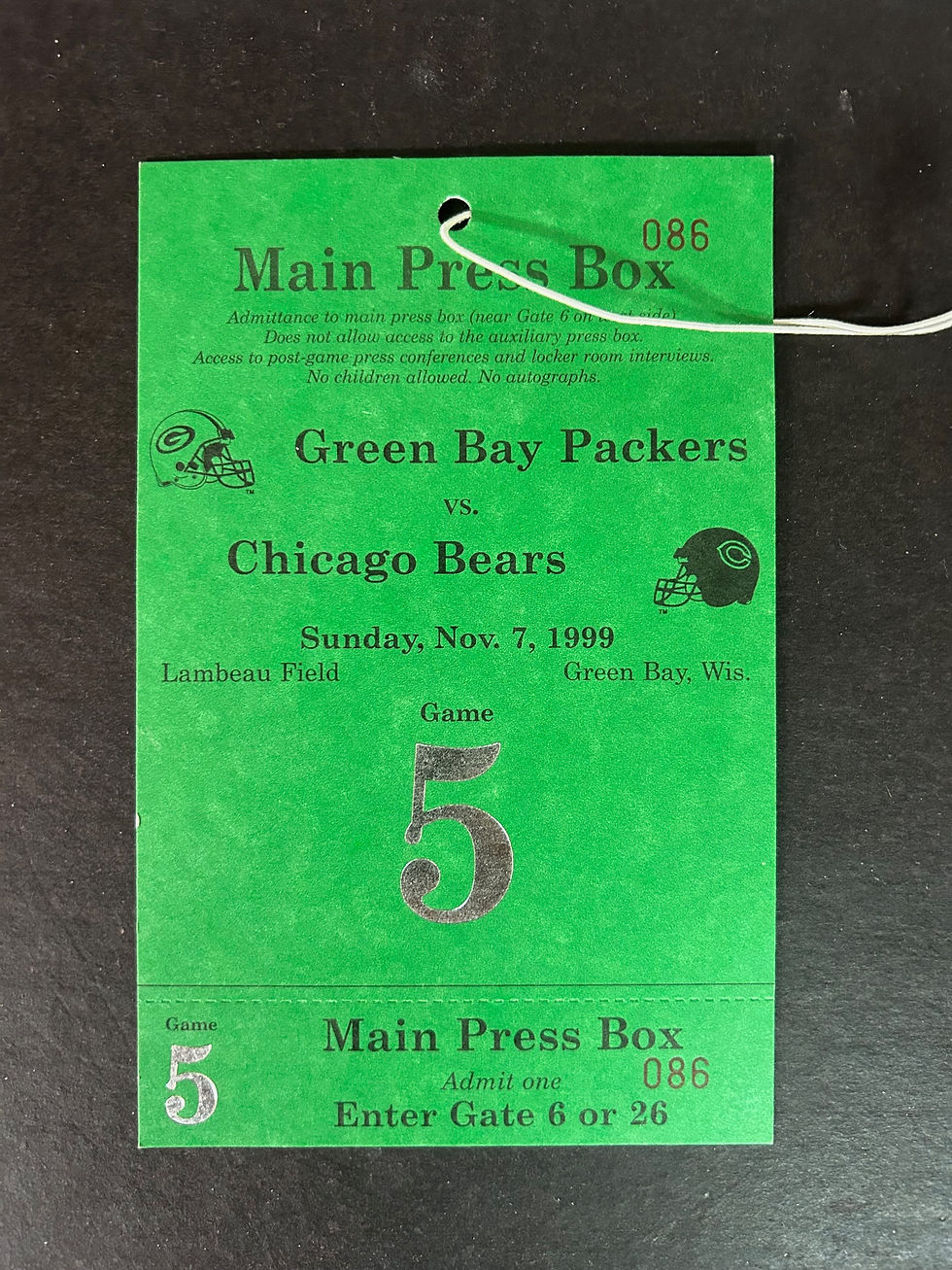
After an emotional week following the death of revered Bears Hall of Fame running back Walter Payton at 45 of bile duct cancer, there was no telling what to expect when the Bears headed up to Green Bay to face the Packers at Lambeau Field. The Bears were 3-5 with three consecutive losses in Dick Jauron's first season. The Packers were 4-3 in Ray Rhodes' first season.
An uninspiring game turned into one of the best storybook endings of my career. Leading 14-13 in the fourth quarter, the Bears seemed destined to lose in dispiriting fashion after Chris Boniol missed a 34-yard field goal that would have forced Brett Favre and the Packers to score a touchdown to win. Instead, Favre easily drove the Packers for a chip shot field goal in the final seconds. But — miracle of miracles — Bears defensive tackle Brian Robinson blocked Ryan Longwell's 28-yard attempt as time expired and the Bears won one for Walter, 14-13.
"I think Walter Payton actually picked me up a little and boosted me into the air," Robinson said after the game. "I know he did because I can't jump that high."
It sure seemed like divine intervention. In fact, even Boniol's earlier miss seem to benefit the Bears. Had Favre — who had beaten the Bears 10 consecutive times at that point — needed a touchdown instead of settling for the field goal, Bears fans know he probably would have gotten it.

The Bulls won six NBA titles with Michael Jordan from 1991-98, but their dominance was never greater than the 1995-96 season — reaching an absolute peak in Game 3 of the NBA Finals.
After setting an NBA record for victories by going 72-10 in the regular season, they rampaged through the playoffs. They swept the Head 3-0 (winning by 17, 31 and 21 points), beat the Knicks 4-1 in the conference semifinals and swept the Magic 4-0 in the conference finals.
After taking a 2-0 lead over the Supersonics in the NBA Finals with victories at the United Center, the Bulls were 13-1 in the playoffs. At that point, Key Arena — where the Sonics wre 38-3 in the regular season, including a 97-92 victory over the Bulls — was the last firewall to their dominance. It was clear that Game 3 would be the Bulls' biggest challenge of the entire season.
The Bulls responded to that challenge by taking their already superior game to another level. They led 7-0, 13-2, 19-4 and 32-12 in the first quarter and 62-38 at halftime. They took their foot off the gas in the second half, but still were never challenged in a 108-86 lead that gave them a 3-0 lead in the series.
The series was over. The series was so over that the following off day between games, not only were Bulls owner Jerry Reinsdorf and general manager Jerry Krause made available for media interviews, but both addressed questions about the future, the 1995-96 team's legacy without hesitancy. Unwittingly perhaps, it was the equivalent of Red Auerbach's victory cigar.
The Bulls coasted the rest of the way. They lost Games 4 and 5 at Key Arena before winning Game 6 87-75 at the United Center to clinch their fourth NBA title in six seasons. They would win in similar dominant fashion again in 1997 and again in 1998, but they would never reach the heights they did in Game 3 of the 1996 Finals, when they ruled the NBA world like no team has before.

Comments